


The Voice Agent Opportunity – Deploying AI for Real, Measurable Business Results
Executive Summary AI voice agents have joined the ranks of proven technologies that forward-thinking companies are using to accelerate growth, reduce costs, and increase customer satisfaction. Leading platforms…
August 12, 2026 · 8 min read
Executive Summary
AI voice agents have joined the ranks of proven technologies that forward-thinking companies are using to accelerate growth, reduce costs, and increase customer satisfaction. Leading platforms today combine speech-to-speech pipelines with large language models, CRM and calendar system integrations, analytics, and regulatory tools while delivering natural conversation with latencies below 300 ms, interruption handling above 90%, and economics of $0.04–$0.80 per dial vs. $100–$300+ per human SDR appointment.
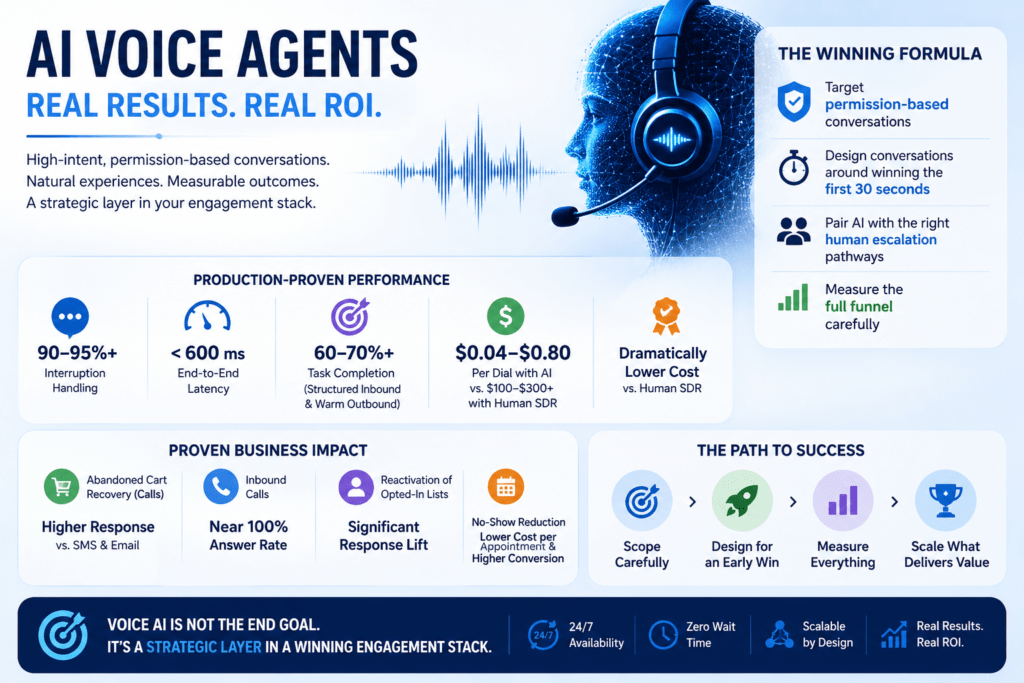
The businesses generating the best returns from voice agents are those that are:
- Targeting permission-based conversations
- Designing conversations around winning the first 30 seconds of dialogue
- Pairing AI with appropriate human escalation pathways
- Measuring the full funnel carefully
As a result, the results speak for themselves. Compared to SMS and email, call-based recovery of abandoned carts sees higher response rates, inbound calls demonstrate near-100% answer rates, reactivation of opted-in lists produces significant response lift, and no-show reduction drives down costs per appointment while improving conversion versus human SDR-only options.
Indeed, there is real opportunity for voice AI deployment. It is not that these solutions are universally applicable, but that the companies using them are seeing substantial benefits from focused application within their calling processes. The path to success is clear: scope carefully, design for an early win, measure everything, and treat voice AI not as an end in itself but as a means to an end — a strategic layer in a wider engagement stack.
The Opportunity and Context
AI voice agents are becoming established technologies. The novelty has worn off, and the early “could this possibly work?” questions have been replaced by practical assessments of efficacy, scalability, and value extraction. Modern platforms encompass speech-to-speech pipelines, large language models, CRM and calendar system integration, analytics, and regulatory tools in comprehensive offerings. The technical hurdles have been cleared; the main remaining challenges are around tactical deployment and value extraction — areas where forward-thinking companies are already realizing substantial rewards.
Voice AI achieves its greatest success in carefully chosen use cases that exploit its strengths while avoiding weaknesses. Voice AI excels at high-volume, high-intent, permission-based conversations with clear outcomes. Used in appropriate applications, it can generate conversion rates comparable to human interactions while dramatically reducing labor costs and accelerating appointment-setting cadence. Additionally, inbound applications see hold rates and conversion approaching those of live agents, with 24/7 availability.
Voice AI technology has moved far beyond the limitations that plagued early IVR systems and robocalling solutions. The leading platforms deliver:
| Metric | Performance |
| Interruption handling | 90–95%+ |
| End-to-end latency | Below 600 ms |
| Task completion (structured inbound & warm outbound) | 60–70%+ |
| Cost per dial vs. human SDR | Dramatically lower |
These are all production results — not theory or wishful thinking. Voice AI works when it is deployed correctly, and there is opportunity for substantial volume and value extraction for companies that understand how to operate this technology stack.
Why Voice AI Works – When Used Well
Voice AI is ideally suited to high-volume, high-intent, permission-based conversations with clear outcomes.
Modern voice AI platforms have overcome the limitations that plagued early robotic outbound calling systems and IVR implementations. When applied to the right use cases — those that are permission-based, high-intent, and have clearly defined outcomes — voice AI produces conversion rates comparable to human interactions while dramatically reducing labor costs and accelerating cadence. Additionally, inbound usage shows hold rates and conversions approaching those of live agents, with 24/7 availability and zero wait time.
Best-Fit Use Cases
Opportunities for voice AI deployment tend to fall into a handful of categories:
1. High-Intent Inbound Conversations Encompassing a wide range of use cases from appointment qualification and support escalations to general receptionist duties. Voice AI solutions perform exceptionally well in this space, routinely achieving hold rates and conversion comparable to human agents.
2. Warm Outbound Conversations Including callbacks on demo form submissions, abandoned cart follow-ups, and appointment reminders and confirmation calls. These use cases tend to be high-intent, permission-based interactions with clearly defined outcomes that voice AI can reliably deliver on.
3. High-Intent Qualified Outreach Including reactivation of opted-in lists or other high-value, warm opportunities where contact has already established prior intent.
4. Structured Qualification Campaigns Deployed across any of the above categories to great effect. Structured qualification campaigns enable consistent, repeatable conversations that can be continuously optimized for conversion.
Each of these use cases shares several characteristics that make them ideally suited to voice AI deployment: all are high-intent, permission-based conversations with clearly defined outcomes, and all can benefit enormously from the speed and consistency of a voice AI solution. Voice AI is not a cure-all for every type of conversation — but it is an incredibly powerful tool that can deliver substantial benefits when deployed correctly.
The Winning Deployment Playbook
Research and production data identify several best practices that distinguish the most successful voice AI deployments.
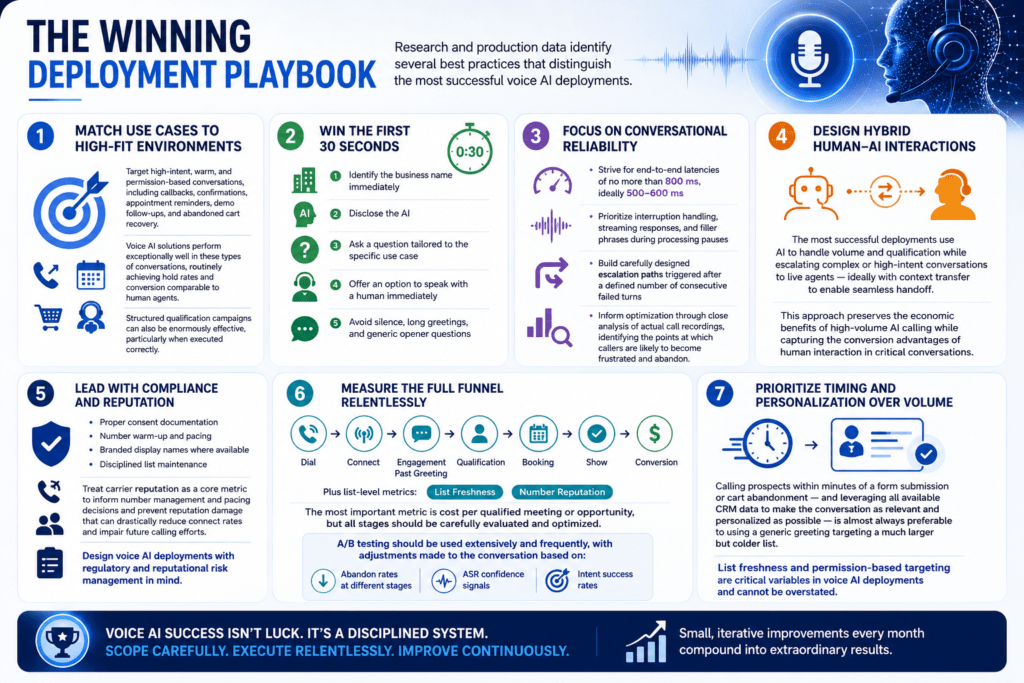
1. Match Use Cases to High-Fit Environments
Target high-intent, warm, and permission-based conversations, including callbacks, confirmations, appointment reminders, demo follow-ups, and abandoned cart recovery. Voice AI solutions perform exceptionally well in these types of conversations, routinely achieving hold rates and conversion comparable to human agents. Structured qualification campaigns can also be enormously effective, particularly when executed correctly.
2. Win the First 30 Seconds
The beginning of every conversation is the most critical time. Best-in-class scripting follows this sequence:
- ✅ Identify the business name immediately
- ✅ Disclose the AI
- ✅ Ask a question tailored to the specific use case
- ✅ Offer an option to speak with a human immediately
- ❌ Avoid silence, long greetings, and generic opener questions
3. Focus on Conversational Reliability
- Strive for end-to-end latencies of no more than 800 ms, ideally 500–600 ms
- Prioritize interruption handling, streaming responses, and filler phrases during processing pauses
- Build carefully designed escalation paths triggered after a defined number of consecutive failed turns
- Inform optimization through close analysis of actual call recordings, identifying the points at which callers are likely to become frustrated and abandon the conversation
4. Design Hybrid Human–AI Interactions
The most successful deployments use AI to handle volume and qualification while escalating complex or high-intent conversations to live agents — ideally with context transfer to enable seamless handoff. This approach preserves the economic benefits of high-volume AI calling while capturing the conversion advantages of human interaction in critical conversations.
5. Lead with Compliance and Reputation
Proper consent documentation, number warm-up, pacing, branded display names where available, and disciplined list maintenance are critically important and should be prioritized at all times. Treating carrier reputation as a core metric informs number management and pacing decisions and prevents reputation damage that can drastically reduce connect rates and impair future calling efforts. Voice AI deployments should always be designed with regulatory and reputational risk management in mind.
6. Measure the Full Funnel Relentlessly
Instrument every stage:
Dial → Connect → Engagement Past Greeting → Qualification
  → Booking → Show → Conversion
Plus list-level metrics: list freshness and number reputation.
The most important metric is cost per qualified meeting or opportunity, but all stages should be carefully evaluated and optimized. A/B testing should be used extensively and frequently, with adjustments made to the conversation based on:
- Abandon rates at different stages
- ASR confidence signals
- Intent success rates
Teams that are making iterative improvements on a monthly basis are significantly more likely to succeed than those that set and forget.
7. Prioritize Timing and Personalization Over Volume
Calling prospects within minutes of a form submission or cart abandonment — and leveraging all available CRM data to make the conversation as relevant and personalized as possible — is almost always preferable to using a generic greeting targeting a much larger but colder list. The use of list freshness and permission-based targeting as critical variables in voice AI deployments cannot be overstated.
What Real Success Looks Like
The companies seeing the best results from voice AI deployments are those using it as an enabler — to accelerate their existing processes rather than as an end in itself. These companies are enhancing their existing workflows, calling back high-intent abandoners, and sending appointment reminders that reduce no-shows, all while realizing substantial improvements in:
- Coverage and reach
- Speed-to-lead
- Recovery rates
- Cost efficiency — without proportional headcount growth
Voice AI is being incorporated strategically into broader customer engagement ecosystems, and these companies are seeing the rewards in both increased conversions and improved customer experience. As voice AI becomes more prevalent, software vendors are evolving from automation sellers to outcome partners — helping their clients identify the right use cases, design the conversations, measure the results, and implement solutions at scale. In this environment, every conversation is an opportunity to improve the AI models while simultaneously refining the business processes they are integrated with.
The businesses leveraging voice AI for real, measurable results are those that are:
- Enhancing their existing processes with voice AI
- Realizing substantial improvements in coverage, speed-to-lead, recovery, and cost efficiency
- Elevating the customer experience through the strategic use of this technology
These companies are successfully navigating the regulatory and reputational challenges that accompany voice-based outreach, ensuring that their campaigns are both effective and sustainable in the long term. As voice AI becomes a ubiquitous part of the customer engagement landscape, these businesses are positioning themselves for continued growth and success by leveraging this powerful technology in a responsible, strategic manner.
Built in Practice
We have not just studied this space — we have designed and developed a production-ready enterprise voice agent from the ground up.
Our end-to-end implementation covers the full architecture: low-latency speech pipelines, LLM-driven conversation design, CRM integration, hybrid human escalation, compliance guardrails, and full-funnel instrumentation — everything described in this document, engineered and deployed at enterprise scale.
📖 Read the full technical deep-dive: Engineering a Production-Ready Enterprise Voice Agent
Go deeper
Have the same problem, different constraints?
These notes are general by necessity. Tell us the specifics and we will tell you how we would approach it.
We reply within one business day