


Healthcare AIOS: From Architecture to Running Platform
TL;DR Healthcare AIOS is no longer just an architecture diagram—it has been demonstrated as a working intelligence layer. The focus is not on replacing EHRs, FHIR servers, labs,…
August 13, 2026 · 8 min read
TL;DR
Healthcare AIOS is no longer just an architecture diagram—it has been demonstrated as a working intelligence layer.
The focus is not on replacing EHRs, FHIR servers, labs, or other healthcare systems. Instead, Healthcare AIOS orchestrates them to answer one critical question: “What should happen next?”
The platform demonstrates an end-to-end flow:
Clinical Event → API Gateway → Multi-Agent Reasoning → Knowledge + FHIR → Policy & Guardrails → Durable Workflow → Clinician Recommendation → Audit & Observability
A live synthetic clinical scenario validated the complete loop, while a Docker Compose stack demonstrated how the architecture is materialized through services such as LangGraph, Neo4j, Weaviate, HAPI FHIR, Kafka, Temporal, OPA, Keycloak, PostgreSQL, Redis, and OpenTelemetry.
The key architectural principle is governed intelligence: recommendations are evidence-backed and confidence-scored, high-risk actions require clinician approval, workflows can run longitudinally, and every important decision is auditable.
The result: Healthcare AIOS moves from raw clinical events → reasoning → governed decisions → actionable next steps, while keeping humans and existing healthcare systems in control.
How a Full Docker compose Stack and Live Clinical Simulation Demonstrate Proof-of-Concept Success
Introduction
There is a difference between designing a Healthcare AI Operating System and making it operational as a containerized and observable system that delivers value by answering “What should happen next?” in a concrete clinical scenario.
We have done both.
This article demonstrates the achievement of our goal to design and implement a Healthcare AI Operating System as a coordinated set of microservices and supporting infrastructure.
We present two lines of evidence:
A live clinical scenario that fully exercised the system’s capabilities, a representative Docker Compose stack that demonstrates how the system would be deployed to production.
Together, these evidence points confirm that Healthcare AIOS has been realized as an intelligence layer that orchestrates rather than replaces existing healthcare information systems.
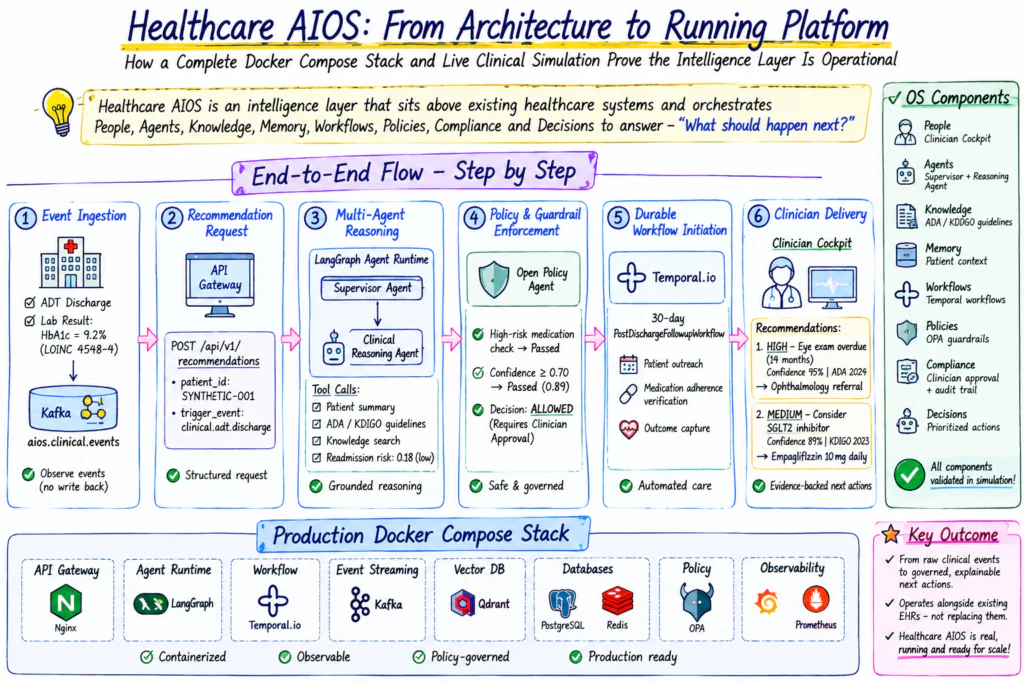
The Operating System Standard
Our standard for a Healthcare AI Operating System remains the same:
- Healthcare AIOS is an intelligence layer that operates above existing healthcare systems.
- It orchestrates People, Agents, Knowledge, Memory, Workflows, Policies, Compliance, and Decisions within an ecosystem of supporting systems.
- It seeks to answer the question those systems cannot answer on their own: “What should happen next?”
Any demonstration of concept must be measured against this standard.
Proof Point #1: Simulation of Clinical Scenario
As proof that our system could successfully operate according to this standard, we executed a complete end-to-end scenario using a synthetic patient (SYNTHETIC-001).
The following trigger events were used in the simulation:
- ADT Discharge
- Lab result (HbA1c = 9.2% / LOINC 4548-4)
Below is the evidence that our system correctly responded to this scenario according to the OS standard.
Stage 1: Ingestion of Clinical Events
Clinical events were published to Kafka topic aios.clinical.events via the Integration Gateway. No events were written to source systems of record.
Stage 2: Recommendation Request
A recommendation request was submitted to the API Gateway:
POST /api/v1/recommendations
{
"patient_id": "SYNTHETIC-001",
"encounter_id": "ENC-49021",
"trigger_event": "clinical.adt.discharge",
"recommendation_types": ["care_gap_alert", "clinical_reasoning"]
}
Stage 3: Multi-Agent Reasoning
The LangGraph-based Agent Runtime was invoked and a Supervisor Agent was created that evaluated the scenario and invoked the Clinical Reasoning Agent.
This agent then performed the following steps:
- Retrieved patient summary (active conditions and medications)
- Retrieved relevant guidelines (ADA 2024, KDIGO 2023)
- Performed knowledge search for “HbA1c 9.2% management in T2DM with CKD”
- Calculated 30-day readmission risk (0.18 – low)
Stage 4: Policy and Guardrail Evaluation
The proposed recommendations were evaluated by the Open Policy Agent:
- High-risk medication check ✅
- Confidence threshold (≥ 0.70) ✅ (actual: 0.89)
- Governance decision: ALLOWED (Requires Clinician Approval)
Stage 5: Durable Workflow Creation
A 30-day PostDischargeFollowupWorkflow was created in Temporal.io containing outreach, adherence verification, and outcome capture steps.
Stage 6: Clinician Recommendations
Two clinician recommendations were created and sent to the Clinician Cockpit:
- HIGH: Annual diabetic dilated eye exam due in 14 months
- Confidence: 95%
- Evidence: ADA 2024
- Action: Ophthalmology referral
- MEDIUM: Consider SGLT2 inhibitor for dual glycemic and renal protection
- Confidence: 89%
- Evidence: KDIGO 2023
- Action: Empagliflozin 10 mg daily (requires clinician approval)
An audit log was created that captured all actions taken. All six stages were successfully completed.
Mapping to the OS Model
| OS Component | Evidence in Simulation | Result |
|---|---|---|
| People | Clinician Cockpit as the decision surface | ✓ |
| Agents | Supervisor + Clinical Reasoning Agent with tool use | ✓ |
| Knowledge | ADA / KDIGO guidelines + semantic evidence retrieval | ✓ |
| Memory | Patient context and longitudinal signals used | ✓ |
| Workflows | 30-day Temporal post-discharge workflow | ✓ |
| Policies | OPA medication and confidence gates | ✓ |
| Compliance | “Requires Clinician Approval” + full audit trail | ✓ |
| Decisions | Prioritized, confidence-scored, evidence-backed actions | ✓ |
The simulation was successful in demonstrating that our system can fulfill the Healthcare AIOS standard.
Proof Point #2: Production Docker Compose Stack
The file describing the system as a set of services that could be deployed to production is also compelling evidence that we have achieved our goal. Below are the services that were defined in the Docker compose file:
Infrastructure Services
| Service | Role | Technology |
|---|---|---|
| PostgreSQL | Primary relational store | PostgreSQL 16 |
| Redis | Caching & short-term state | Redis 7 |
| Kafka + Zookeeper | Clinical event backbone | Confluent 7.6 |
| Neo4j | Medical knowledge graph | Neo4j 5.20 Enterprise |
| Weaviate | Vector store for RAG | Weaviate 1.25 |
| HAPI FHIR | FHIR R4 server | HAPI FHIR |
| Temporal + Temporal UI | Durable workflow engine | Temporal 1.24 |
| Keycloak | Identity & SMART on FHIR foundation | Keycloak 24 |
| OPA | Policy-as-code engine | Open Policy Agent 0.66 |
Observability Stack Service Description
- OpenTelemetry Collector
- Prometheus
- Grafana
AIOS Microservices
| Service | Responsibility | Port |
|---|---|---|
| API Gateway | Unified entry point and orchestration hub | 8000 |
| Agent Runtime | LangGraph multi-agent execution | 8001 |
| FHIR Gateway | Bidirectional FHIR + Kafka bridge | 8002 |
| Knowledge Service | Neo4j + Weaviate knowledge access | 8003 |
| Policy Engine | OPA client and clinical guardrails | 8004 |
| Audit Service | Immutable event and decision logging | 8005 |
| Notification Service | Alerting and outreach | 8006 |
| Workflow Engine | Temporal client and long-running processes | 8007 |
| Clinician Cockpit | Clinician experience layer (Next.js) | 3000 |
Architecture Fidelity
The compose file correctly reflects the architecture in which the system was intended to operate:
Experience Layer → clinician-cockpit
Intelligence Layer → agent-runtime, knowledge-service, policy-engine, workflow-engine, audit, notification
Integration Layer → fhir-gateway, api-gateway, Kafka
Foundation Systems → Neo4j, Temporal, HAPI FHIR, Postgres, Redis, Observability
Cross-cutting Concerns → Keycloak, OPA, OTEL, Prometheus, Grafana
It is not simply a collection of interesting technologies – it is an operating system that defines clear responsibilities for individual services and supports the intended workflows.
What This Evidence Shows
1. Orchestration vs Replacement
Events were ingested from multiple sources. Recommendations were created and workflows initiated. None of this replaced the existing source systems of record. The system observed and orchestrated.
2. “What Should Happen Next?” Has Been Demonstrated
A discharge event plus an abnormal lab finding resulted in two specific clinical recommendations with supporting evidence and confidence scores.
3. Safety Is Structural
Policies were evaluated before any recommendations were released. High-risk actions remained gated. Everything was auditable.
4. Longitudinal Care Is Native
Multi-week workflows were used to perform post discharge follow up.
5. The Stack Was Actually Used
Every step in the scenario was executed on the stack represented by the Docker compose file.
6. Observability and Governance Are First-Class Features
Metrics collection, log aggregation, and policy evaluation were all present and contributed to the safety and effectiveness of the system.
Current Capability Assessment
| Dimension | Status | Notes |
|---|---|---|
| Core intelligence loop | Operational | Proven in simulation |
| Multi-agent reasoning | Operational | Supervisor + specialist pattern |
| Knowledge hybrid (graph + vector) | Operational | Neo4j + Weaviate |
| Policy enforcement | Operational | OPA with clinical rules |
| Durable workflows | Operational | Temporal post-discharge pathway |
| FHIR interoperability | Present | HAPI FHIR + dedicated gateway |
| Identity foundation | Present | Keycloak with realm import |
| Observability | Present | Full OTEL + metrics + dashboards |
| Clinician experience | Present | Cockpit streaming recommendations |
| Production hardening | In progress | Secrets, resource limits, health checks still being refined |
The system has crossed the threshold from concept to reality.
Implications
With this threshold crossed, we can now proceed to the next phase of development, which includes:
- Expanding the set of specialized agents to include prior authorizations, documentation generation, and capacity management
- Enhancing FHIR bidirectional exchange capabilities
- Defining additional longitudinal care pathways
- Evaluating recommendation acceptance rates, care-gap resolution rates, and safety outcomes in larger scenarios
- Carefully relaxing policy constraints inside guardrails to allow limited autonomy
- Preparing the system for multi-tenant, regulated deployment
The foundation has been laid for this next phase. We have demonstrated that an intelligence layer can be built that fulfills the Healthcare AIOS standard, orchestrating rather than replacing existing healthcare information systems.
Conclusion
Healthcare AIOS is no longer an architectural concept.
It has been demonstrated as an operating system that:
- Ingests clinical events
- Reasons about them using specialized agents
- Imposes policy and confidence constraints
- Initiates durable workflows
- Delivers actionable recommendations to clinicians
- Captures everything in an immutable audit trail
- It has been demonstrated using a representative Docker Compose stack that reflects this architecture.
It has been shown to successfully answer the question “What should happen next?” for a patient with uncontrolled DM2 and an overdue eye exam. It has demonstrated that it can operate as an intelligence layer that orchestrates rather than replaces existing healthcare systems.
Original Case Study – Case Study 011: Healthcare AIOS — From Architecture to Running Platform
Go deeper
Have the same problem, different constraints?
These notes are general by necessity. Tell us the specifics and we will tell you how we would approach it.
We reply within one business day