


RevSignalAI: From CRM Data to Revenue Intelligence
Why the next generation of sales technology needs to understand what is happening—not just what is recorded Sales teams are drowning in data. CRMs dutifully log opportunities, stages,…
September 22, 2026 · 9 min read
Why the next generation of sales technology needs to understand what is happening—not just what is recorded
Sales teams are drowning in data. CRMs dutifully log opportunities, stages, contacts, amounts, and close dates. Email systems capture the back-and-forth. Calendars track the meetings. Zoom and its peers record who showed up and for how long. On paper, the picture looks complete.
Yet one question still trips people up more often than it should:
Is this deal actually as healthy as the CRM claims?
That question is exactly where RevSignalAI starts.
RevSignalAI is a Revenue Integrity Platform built to sit above the tools sales teams already use. It doesn’t replace the CRM. It isn’t another call recorder. And it isn’t just one more dashboard.
Its job is simpler and more useful: turn the scattered signals sitting in CRM, email, calendar, and meeting systems into clear, evidence-backed intelligence about the real health of every open deal.
The problem: Your CRM records the deal. It doesn’t always reveal it.
Picture a deal marked Commit.
The CRM shows:
- $1M opportunity
- Stage: Commit
- Economic Buyer identified
- Close date: September 30
- Open for 90 days
Looks solid.
But dig a little deeper and the story can change fast:
- The Economic Buyer hasn’t replied in nine days.
- The Champion has gone quiet.
- The same objection keeps surfacing in conversation after conversation.
- The close date has already slipped four times.
- Only one person from the customer side is still engaged.
- Someone mentioned bringing the CFO in—and then nothing happened.
None of those details show up as neat CRM fields. That’s the gap. CRM data tells you what someone bothered to record. Revenue intelligence has to tell you what the evidence actually shows.
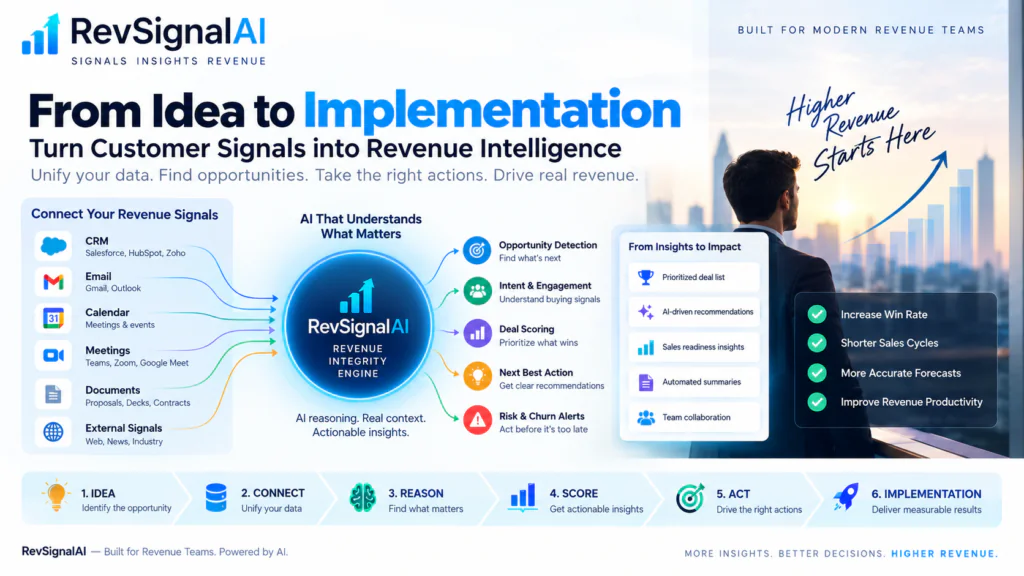
How RevSignalAI works
The approach is deliberately straightforward:
CRM + Email + Calendar + Meetings → Signal Detection → Evidence → Integrity Score → Action
It connects (read-only) to systems like Salesforce, HubSpot, Zoho CRM, Microsoft Dynamics, Gmail, Google Calendar, and supported meeting platforms. Then it cross-references the structured signals those systems already contain, looking for patterns that point to opportunity, risk, or quiet deterioration.
The output is an explainable Revenue Integrity Score for each open deal—along with the evidence that produced it.
Six signals that can rewrite a deal’s story
RevSignalAI currently watches six behavioral patterns:
- Buyer-hosted vs. AE-hosted meetings
Who is really driving the cadence? A buyer who keeps scheduling meetings signals a different level of ownership than an AE who is constantly chasing the next call. The system looks at meeting metadata and ownership patterns to surface this. - Key player absence
A CRM role field can say someone is the Economic Buyer or Champion. It can’t tell you whether that person is still engaged. RevSignalAI tracks meaningful engagement against role-specific expectations and asks the practical question: Is the person who matters still showing up? - Multi-threading failure
Enterprise deals almost never close on the strength of one contact. When a deal stays locked to a single stakeholder with no new people entering the conversation, the risk is structural. The platform looks at thread breadth and participation to flag it. - Key player mentioned without follow-up
A customer says, “We should bring our CFO into the next discussion.” That creates an expectation. If the CFO never appears, the statement becomes an unresolved signal. RevSignalAI tracks these commitments and checks whether the follow-up actually happened. - Close-date volatility
One date change is normal. Four changes without clear buyer-driven reasons is a different story. The system examines close-date history for repeated movement that often points to forecast instability. - Objection looping without resolution
Some objections fade. Others return again and again. Repeated objections across conversations usually mean the underlying issue was never resolved. Detection here combines deterministic pattern matching with language-model assistance to surface the loops.
The guiding principle is simple: the AI does not invent the evidence. It helps interpret it.
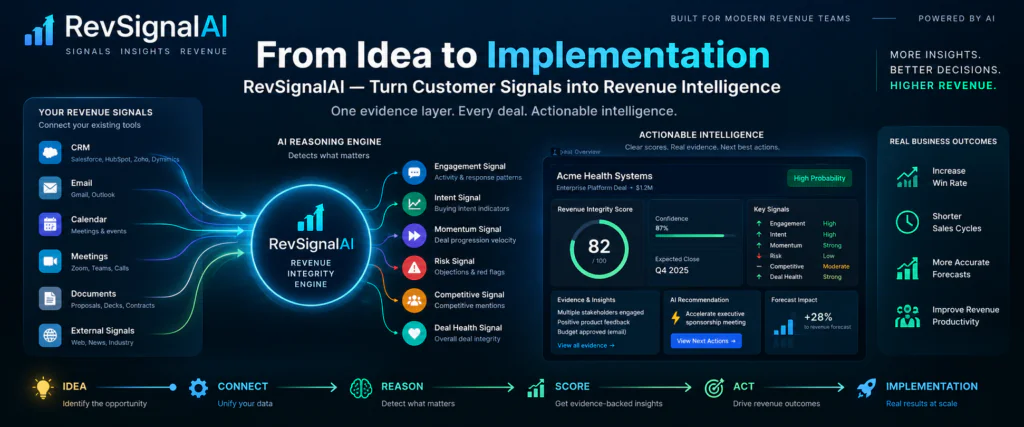
Deterministic signals + AI reasoning (not the other way around)
A core design choice matters here. AI should not become the source of truth just because it is available. Where CRM data is authoritative, it stays authoritative. Deterministic rules first identify measurable patterns. Language models then help with interpretation only where the structured systems lack context.
The flow is:
Authoritative data → Deterministic detection → AI-assisted inference → Evidence → Decision
Not:
LLM → Guess → Dashboard
That distinction is critical when the output influences forecasts, coaching, and executive decisions.
Every score needs an explanation
A score without evidence is just another black box. RevSignalAI treats explainability as part of the product, not an afterthought.
Instead of “This deal is risky,” the system can say:
- Economic Buyer silent for 9 days — Gmail + CRM role data — confidence 0.94
- CFO mentioned but no follow-up detected after 48 hours — confidence 0.91
- Close date moved three times in the last 30 days — confidence 0.88
This produces what we call the Deal Evidence Ledger.
Each signal carries:
- What happened
- Which system supplied the evidence
- When it occurred
- Why it matters
- Confidence level
- Impact on the deal
The rule is straightforward: every important conclusion should be traceable back to evidence.
One evidence layer, different views by role
The same underlying evidence serves different needs:
Account Executive
They don’t need another analytics dashboard. They need to know what to do next. The AE view centers on the integrity score, the specific signals, what’s missing, recommended next actions, and enough self-awareness that a manager doesn’t have to intervene first.
Sales Manager
Managers can stop reviewing every deal by gut feel. They see pipeline health, risk signals, coaching triggers, deals that need attention, and the evidence behind the risk. Coaching shifts from “I don’t feel good about this deal” to “The Economic Buyer has been inactive for nine days and the close date has already moved twice.”
CRO / CFO
Executives care about a different question: How much of the committed revenue is actually supported by evidence? Their view focuses on verified versus at-risk revenue, forecast confidence, pipeline integrity, revenue exposure, and evidence-backed narratives.
RevOps
RevOps needs control—signal configuration, business rules, connector health, data coverage, role-based access, and full auditability.
The evidence stays the same. The interpretation changes with the role.
Integrity score versus outcome prediction
An integrity score and an outcome prediction answer different questions.
The integrity score asks: How much risk or strength is visible in this deal right now?
An outcome prediction asks: Given similar historical deals, what tended to happen next?
RevSignalAI keeps these as separate layers. The prediction engine can use historical outcomes and calibration to estimate probabilities (WIN → SLIP → LOSS), but it never invents a forecast from thin air. The order remains: evidence first, historical outcomes second, prediction third. That separation is what makes the system trustworthy.
Privacy by design
Revenue data is sensitive. A platform that analyzes sales activity has to decide not only what it can understand, but what it should keep.
RevSignalAI is built around a zero-copy approach. Raw email content, transcripts, and calendar details are processed in memory rather than stored as the primary record. The persistent layer holds only structured outputs: deal ID, signal type, confidence, timestamp, evidence reference, and derived status.
The architecture also includes read-only integrations, SSO, role-based access, encryption, immutable audit logging, and standard application security controls. Security and governance are treated as architectural constraints from the start, not a final checklist item.
Why this is different from another AI sales assistant
Plenty of tools help salespeople summarize calls, draft emails, or auto-fill CRM notes. Those are useful.
RevSignalAI is solving a different problem.
The question is not “What did the salesperson say?”
The question is “What does all the available evidence tell us about the integrity of this deal?”
Answering that requires stitching together multiple systems: CRM for structure, email for engagement, calendar for meeting behavior, meeting metadata for participation patterns, and historical outcomes for context. AI then reasons across the combined evidence. The result is an intelligence layer that sits across the revenue stack rather than inside any single tool.
From idea to something that actually changes decisions
Building something like this follows a longer path than “idea → LLM → product.”
The real sequence is:
- Idea — Start with a genuine business problem: why do deals that look healthy on paper sometimes collapse with little warning?
- Connect — Link the systems where the relevant signals already live.
- Reason — Cross-reference those signals, separate authoritative data from inference, and look for patterns.
- Score — Turn the evidence into understandable, investigate-able signals. The goal is not another mysterious AI score; it is a score people can interrogate.
- Act — Deliver the right next step to each role: next action for the AE, coaching trigger for the manager, revenue visibility for the CRO, governance for RevOps.
- Implementation — Make the intelligence part of the operating rhythm so it actually changes how decisions get made.
Impressive demos are common. Changing how a sales organization operates is rarer—and more valuable.
The bigger idea: revenue intelligence needs an evidence layer
The next useful step in sales technology may not be another CRM. It may be an intelligence layer that continuously evaluates what is actually happening across the revenue ecosystem:
Systems of Record (CRM)
→ Systems of Engagement (email, calendar, meetings)
→ Signal Intelligence (detection, inference, correlation)
→ Evidence Layer (citations, confidence, timeline)
→ Revenue Integrity (deal score, forecast confidence, risk)
→ Action (next best action, coaching, executive decisions)
That is the direction RevSignalAI is exploring.
Sales teams do not necessarily need more data. They need better interpretation of the data they already have. The shift is from “data → dashboard” to “data → signals → evidence → intelligence → action.”
Your pipeline says it’s healthy. Prove it.
That’s the opportunity: one evidence layer, every deal, actionable revenue intelligence. AI in revenue operations should not replace sales judgment. It should make that judgment better informed—by making the evidence visible early enough that people can still do something about it.
Go deeper
Have the same problem, different constraints?
These notes are general by necessity. Tell us the specifics and we will tell you how we would approach it.
We reply within one business day