


From Prototype to Production: A Practical Playbook for Enterprise Gen AI
Executive Summary Most enterprises build a gen AI prototype in a week. A working demo is not the hard part anymore. The hard part starts after the demo,…
August 7, 2026 · 7 min read
Executive Summary
Most enterprises build a gen AI prototype in a week. A working demo is not the hard part anymore. The hard part starts after the demo, when the system needs to run every day, under real load, with real users, and real consequences when it fails. For more detail refer AI Can Build Your MVP Faster. But It Can’t Build Your Business.
I have shipped RAG systems, voice agents, and multi-agent orchestration pipelines into production across healthcare, telecom, and enterprise SaaS environments. The pattern repeats every time. Teams who treat gen AI as a model selection problem stall. Teams who treat it as an engineering discipline ship. For more detail refer AI-Enabled Organizations Are Redefining What It Means to Be a Great Engineer
This piece lays out the framework I use to move a gen AI system from prototype to something you trust in production.
The Problem
A prototype answers one question: does this work at all?
Production asks a different set of questions:
- Does it work the same way every time you run it?
- Do you have a way to measure when it gets worse?
- Does someone other than the original builder know how to operate it?
- Does it fail safely when the model, the data, or the infrastructure breaks?
Most prototypes never answer these questions, because nobody asked them until launch was already late.
Why This Gap Exists
Foundation models are non-deterministic. The same prompt returns different answers on different days. A traditional software system does not behave this way. A calculator gives you the same answer to the same equation every time. A large language model does not carry this guarantee.
This single fact changes how you need to build. You do not test a gen AI system the way you test a REST API. You need a way to measure quality continuously, not once before launch.
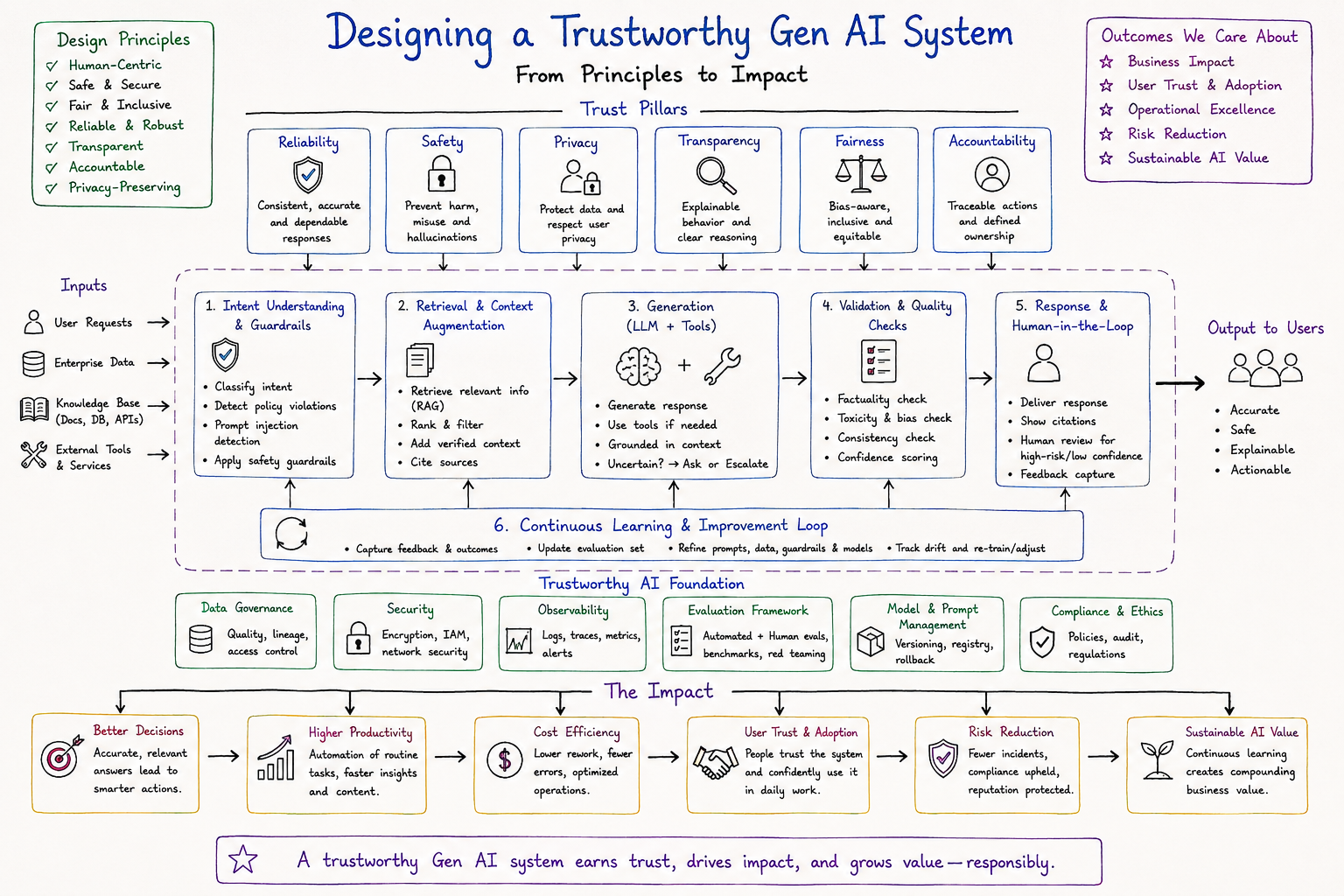
Design Trustworthy Gen AI System
The Framework
I break the journey into six steps. Skip any one of them and you inherit technical debt you pay for later.
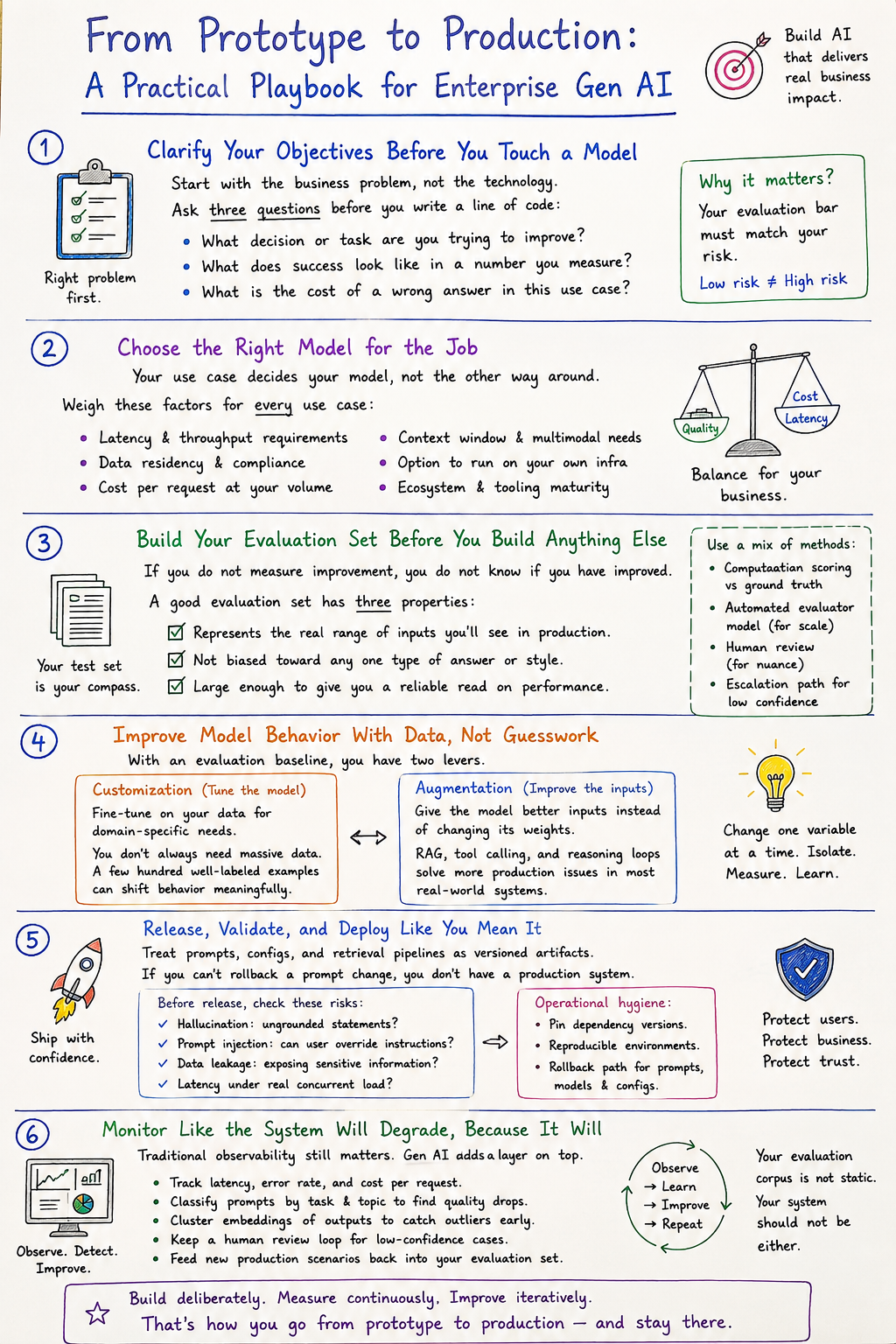
Step 1: Clarify Your Objectives Before You Touch a Model
Start with the business problem, not the technology. Not every problem is an AI problem. Not every AI problem needs a large language model.
Ask three questions before you write a line of code:
- What decision or task are you trying to improve?
- What does success look like in a number you measure?
- What is the cost of a wrong answer in this use case?
A customer support agent with a wrong product recommendation costs you a support ticket. A healthcare assistant with a wrong answer costs you something else entirely. Your evaluation bar has to match your risk.
Step 2: Choose the Right Model for the Job
Your use case decides your model, not the other way around. I have run projects starting on a hosted frontier model and later moved to a self-hosted open model once the cost and latency profile of production traffic became clear. This migration worked because the evaluation setup stayed the same. The model changed. The way we measured quality did not.
Weigh these factors for every use case, not once for the whole organization:
- Latency and throughput requirements
- Data residency and compliance constraints
- Cost per request at your expected volume
- Context window and multimodal needs
- Whether you need the option to run it on your own infrastructure
Large models are a reasonable starting point. They make it easier to build something usable before you optimize. You move to smaller, cheaper, faster models once you know exactly what quality bar you need to hit.
Step 3: Build Your Evaluation Set Before You Build Anything Else
This is the step most teams skip, and it costs them the most later.
If you do not measure improvement, you do not know if you have improved.
A good evaluation set has three properties:
- It represents the real range of inputs your system will see in production.
- It is not biased toward any one type of answer or style.
- It is large enough to give you a reliable read on performance, not a guess.
Build this with people who understand the business context, not only the engineering team. I have seen evaluation sets built entirely by developers miss the exact edge cases showing up in the first week of production traffic.
Use a mix of methods:
- Computational scoring against ground truth, to catch drift fast
- An automated evaluator model for scale
- Human review for anything where nuance matters
- A clear escalation path when confidence is low
Step 4: Improve Model Behavior With Data, Not Guesswork
Once you have an evaluation baseline, you have two levers to pull.
Customization. Fine-tune the model on your data when you have a domain-specific need. A massive dataset is not always required. A few hundred well-labeled examples meaningfully shift behavior on a narrow task.
Augmentation. Give the model better inputs instead of changing its weights. This is where retrieval-augmented generation, tool calling, and multi-step reasoning loops live. In most of my RAG implementations, augmentation solved more production issues than fine-tuning did, because bad retrieval produces bad answers no matter how good the underlying model is.
Change one variable at a time. Tune a model and swap your retrieval pipeline in the same release, and you lose the ability to tell which change caused the regression.
Step 5: Release, Validate, and Deploy Like You Mean It
Treat your prompts, your configuration, and your retrieval pipeline as versioned artifacts, the same way you version your code. If you do not have a rollback path for a prompt change, you do not have a production system.
Before release, check for these risks specifically:
- Hallucination: does the model state things not grounded in your data?
- Prompt injection: does a user override your system instructions?
- Data leakage: does the model expose information it should not?
- Latency under real concurrent load, not single-request testing alone
Pin your dependency versions. I have watched a stable GPU deployment break because a transformers or torch update shipped a breaking change with no code change on our side. Dependency drift is one of the most common causes of a working system suddenly failing.
Step 6: Monitor Like the System Will Degrade, Because It Will
Traditional observability, logs, traces, and metrics, still matters. Gen AI adds a layer on top of it.
- Track latency, error rate, and cost per request continuously.
- Classify prompts by task and topic, so you know exactly where quality drops.
- Cluster embeddings of your outputs to catch outlier behavior before a user reports it.
- Keep a human review loop for the cases your automated evaluators flag as low confidence.
Your evaluation corpus is not static. Your production traffic surfaces tasks your test set never covered. Feed those back into your evaluation set on a regular cadence.
Engineering Decisions With the Most Impact
Across every project I have shipped, the decisions with the most impact were rarely about the model:
- Metrics-driven development over ad hoc testing
- Modular architecture, so you swap a model without rewriting your application
- Explicit dependency management and version pinning
- A feedback loop from production traffic back into your evaluation set
- Governance and security built in from day one, not bolted on before launch
Lessons Learned
The gap between a demo and a production system is not the model. It is the engineering discipline you build around the model.
Foundation models will keep improving. Your competitive advantage is not access to the best model. It is the evaluation setup, the deployment pipeline, and the monitoring system you build to use any model well.
Build the evaluation setup first. The model is replaceable. The discipline is not.
Which step does your team skip most often on the way from prototype to production? I want to know.
Reference –
RAG System – The Real Deal on RAG: What Works, What Doesn’t, and Why You’re Probably Doing It Wrong
Voice Agent – Engineering a Production-Ready Enterprise Voice Agent
Go deeper
Have the same problem, different constraints?
These notes are general by necessity. Tell us the specifics and we will tell you how we would approach it.
We reply within one business day