


Engineering a Production-Ready Enterprise Voice Agent
From Prototype to Enterprise AI Platform Executive Summary Voice has become one of the fastest-growing interfaces for enterprise AI. Organizations are moving beyond traditional chatbots. They are introducing…
August 5, 2026 · 5 min read
From Prototype to Enterprise AI Platform
Executive Summary
Voice has become one of the fastest-growing interfaces for enterprise AI. Organizations are moving beyond traditional chatbots. They are introducing conversational agents capable of understanding natural language and reasoning over enterprise knowledge. They respond with human-like speech.
Although recent advances in Large Language Models have dramatically improved conversational intelligence, speech synthesis remains one of the most challenging components of an enterprise AI system. Unlike text generation, Voice AI requires low latency, GPU acceleration, deterministic deployments, complex dependency management, and robust operational monitoring.
This case study describes the design, development, and production ready of an Enterprise Voice Agent. The objective extended beyond building another text-to-speech application. The goal was to engineer a reusable Voice AI platform capable of supporting AI Meeting Assistants, Customer Support Agents, Knowledge Assistants, and future conversational applications.
The journey exposed an important reality:
Deploying AI models into production is rarely just about obtaining powerful hardware. Modern AI applications depend on a complex ecosystem of CUDA drivers, PyTorch, Transformers, Python packaging, and third-party libraries. A single incompatible dependency can prevent an otherwise healthy GPU deployment from functioning.
The project ultimately transformed an experimental prototype into a scalable GPU-accelerated Voice AI platform suitable for enterprise deployment.
Business Background
Enterprise applications are rapidly evolving from graphical interfaces toward conversational interfaces. Instead of navigating menus, users increasingly expect to interact with software using natural conversation.
Typical enterprise scenarios include:
- AI Meeting Assistants
- Customer Support Automation
- Internal Knowledge Assistants
- Sales Enablement Agents
- Healthcare Assistants
- Interactive Learning Platforms
All of these require one capability: High-quality, low-latency speech generation.
While open-source models have significantly reduced development effort, production deployment remains a major engineering challenge.
Business Problem
The organization successfully developed an initial Voice AI prototype.
The prototype demonstrated:
- Natural sounding speech
- Integration with Large Language Models
- REST API interface
- Successful end-to-end conversations
However, moving beyond demonstration revealed several production concerns.
Operational Challenges
- Long initialization time
- CPU inference bottlenecks
- Environment inconsistencies
- Frequent dependency conflicts
- Manual deployments
- Difficult troubleshooting
- Lack of deployment reproducibility
- Limited production observability
These issues significantly increased operational risk and prevented enterprise adoption.
Business Objectives
The project established the following objectives.
Functional Goals
- Human-quality speech generation
- OpenAI-compatible API
- Enterprise integration
- Future streaming support
Technical Goals
- GPU acceleration
- Stable deployment
- Automated provisioning
- Reproducible environments
Business Goals
- Faster deployment
- Lower operational cost
- Improved reliability
- Scalable architecture
Research Phase
Rather than immediately implementing a solution, several architectural decisions were evaluated.
Infrastructure
The following deployment options were assessed.
- Local GPU Workstations
- Self-managed GPU Servers
- Public Cloud GPU Services
- Thunder Compute
Thunder Compute was selected due to:
- NVIDIA A100 availability
- Simplified provisioning
- Dedicated GPU resources
- Cost effectiveness
- Infrastructure flexibility
Speech Model Evaluation
Several open-source TTS solutions were evaluated against the following criteria:
- Speech quality
- Inference latency
- GPU support
- Deployment complexity
- Extensibility
- Community maturity
The final implementation selected Chatterbox Turbo because it provided an appropriate balance between quality, performance, and deployment flexibility.
Solution Architecture
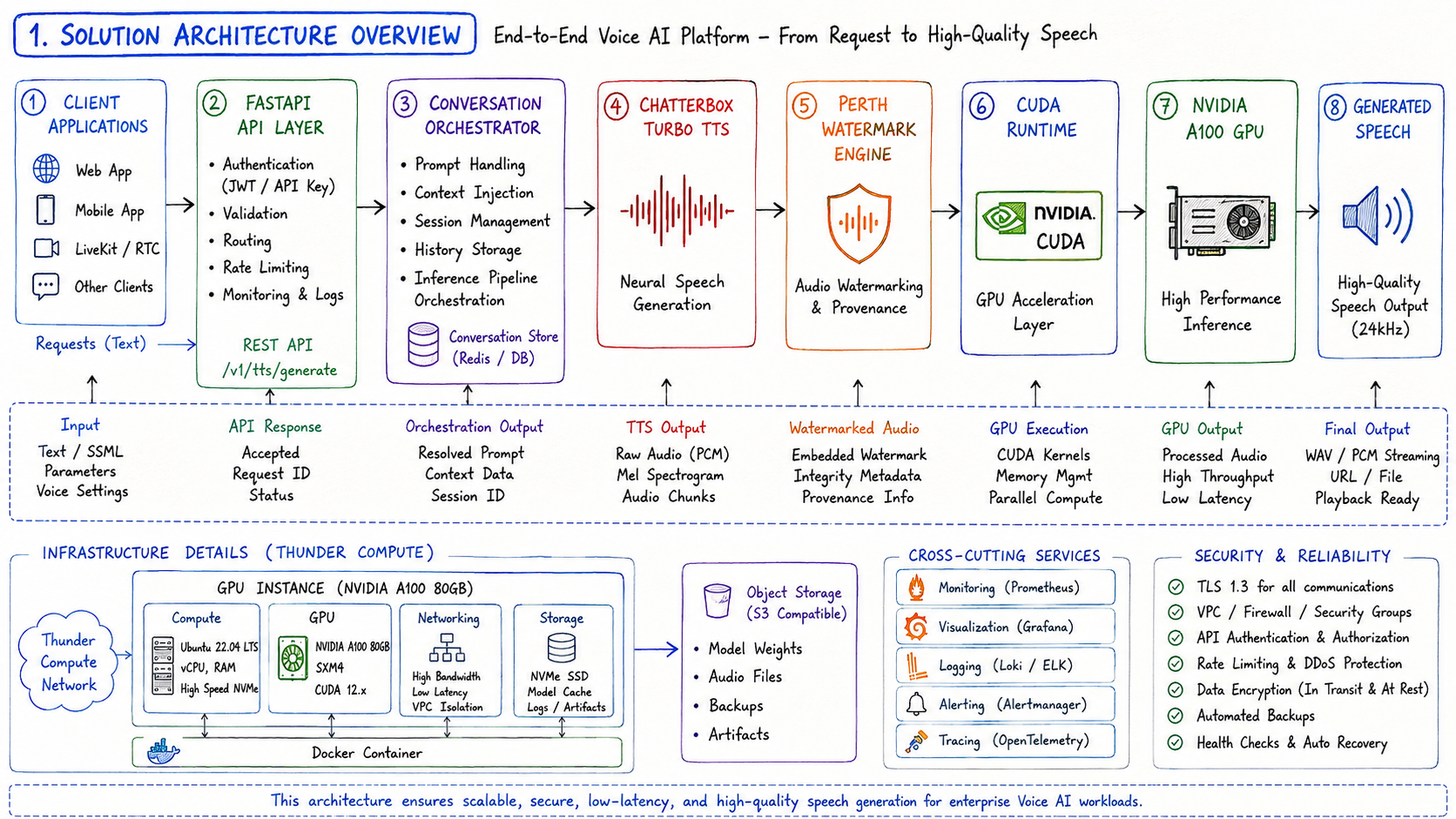
Implementation Strategy
The project followed an incremental implementation approach.
Phase 1
Infrastructure
Deliverables
- GPU provisioning
- CUDA validation
- Python environment
- Runtime verification
Phase 2
Model Deployment
Deliverables
- Model download
- GPU initialization
- Memory validation
- Startup optimization
Phase 3
API Development
Deliverables
- REST interface
- Request validation
- Error handling
- Audio response generation
Phase 4
Production Hardening
Deliverables
- Version pinning
- Startup automation
- Dependency governance
- Deployment repeatability
Technical Challenges
Challenge 1: TorchVision failed during startup
Symptom – RuntimeError: operator torchvision::nms does not exist
Root Cause – Incompatible package versions produced binary mismatches inside the AI runtime.
Resolution – Rebuilt the environment using compatible versions of:
- PyTorch
- TorchVision
- TorchAudio
Challenge 2: Model initialization failed.
Symptom – TypeError: ‘NoneType’ object is not callable
The failure appeared to originate from the speech model.
Further investigation showed the error originated inside the Perth watermark library.
The actual exception was hidden – ModuleNotFoundError pkg_resources
Resolution
Pinned a compatible setuptools version – The watermark engine initialized successfully.
Challenge 3: Dependency Drift
The application code remained unchanged. However several framework updates introduced breaking changes.
Affected technologies included:
- Python Packaging
- Transformers
- TorchVision
- Setuptools
This reinforced the importance of dependency governance.
Engineering Decisions
Several deliberate architectural decisions significantly improved maintainability.
- GPU-first deployment
- Layer-by-layer validation
- Version pinning
- Modular architecture
- Automated environment creation
- Explicit dependency management
Rather than solving individual errors, the objective became eliminating entire categories of deployment failures.
Deployment Flow
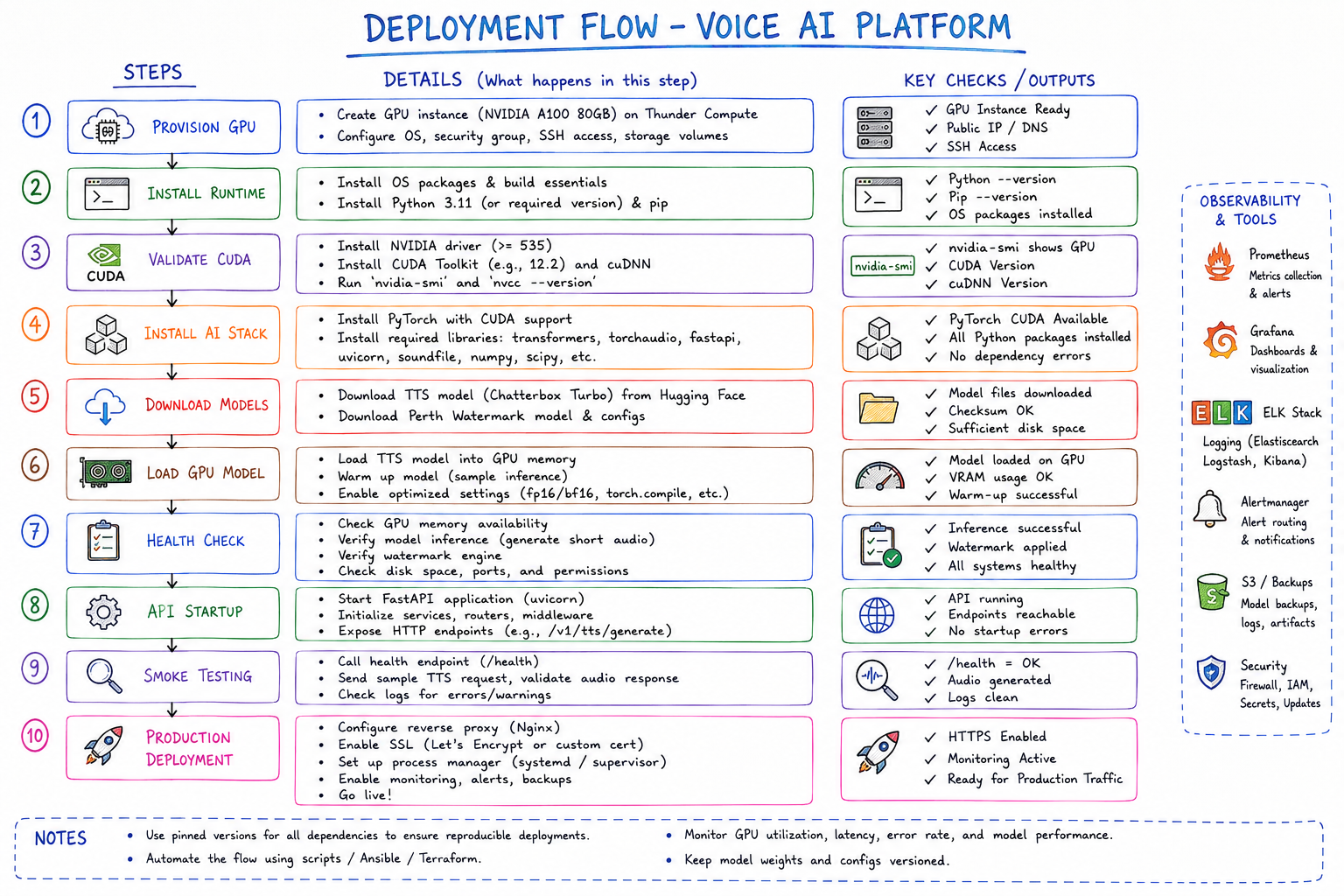
Final Platform
The completed solution provides:
- GPU-accelerated speech synthesis
- Enterprise REST API
- Stable model loading
- Automated deployment
- Reproducible infrastructure
- Production-ready architecture
Business Benefits
The completed platform delivers several measurable benefits.
Operational
- Faster deployments
- Lower maintenance effort
- Simplified troubleshooting
- Stable environments
Technical
- GPU acceleration
- Reliable startup
- Consistent dependency management
- Enterprise scalability
Strategic
The platform now serves as a reusable foundation for future conversational AI products rather than a single-purpose application.
Lessons Learned
The most important lesson from this project was that successful AI deployments depend far more on engineering discipline than on model selection.
Powerful GPUs, modern foundation models, and advanced frameworks are necessary—but they are not sufficient.
Production AI requires careful management of infrastructure, dependency versions, deployment automation, observability, and architectural boundaries.
The difference between a prototype and an enterprise AI platform is not the model itself.
It is the engineering ecosystem built around the model.
Go deeper
Have the same problem, different constraints?
These notes are general by necessity. Tell us the specifics and we will tell you how we would approach it.
We reply within one business day