


9 Types of LLM Evaluation Every Solution Architect Should Design For
LLM evaluation is not just about checking whether an AI answer is correct. In production, we need to know whether the answer is relevant, grounded, safe, reliable, consistent,…
September 25, 2026 · 10 min read
LLM evaluation is not just about checking whether an AI answer is correct. In production, we need to know whether the answer is relevant, grounded, safe, reliable, consistent, and resilient under real-world conditions – right?
As organizations move from AI prototypes to production-grade systems, one of the biggest architectural gaps I keep seeing is evaluation.
Teams often ask: “How accurate is our LLM?”
That is the wrong question.
An enterprise AI system does not fail only because it produces an incorrect answer. It can fail because it answers the wrong question, invents information, violates policy, behaves differently for different users, breaks when the input changes slightly, or produces an answer that cannot be supported by evidence.
From a Solution Architect’s perspective, LLM evaluation should be treated as an architectural capability, not merely a testing activity tacked on at the end.
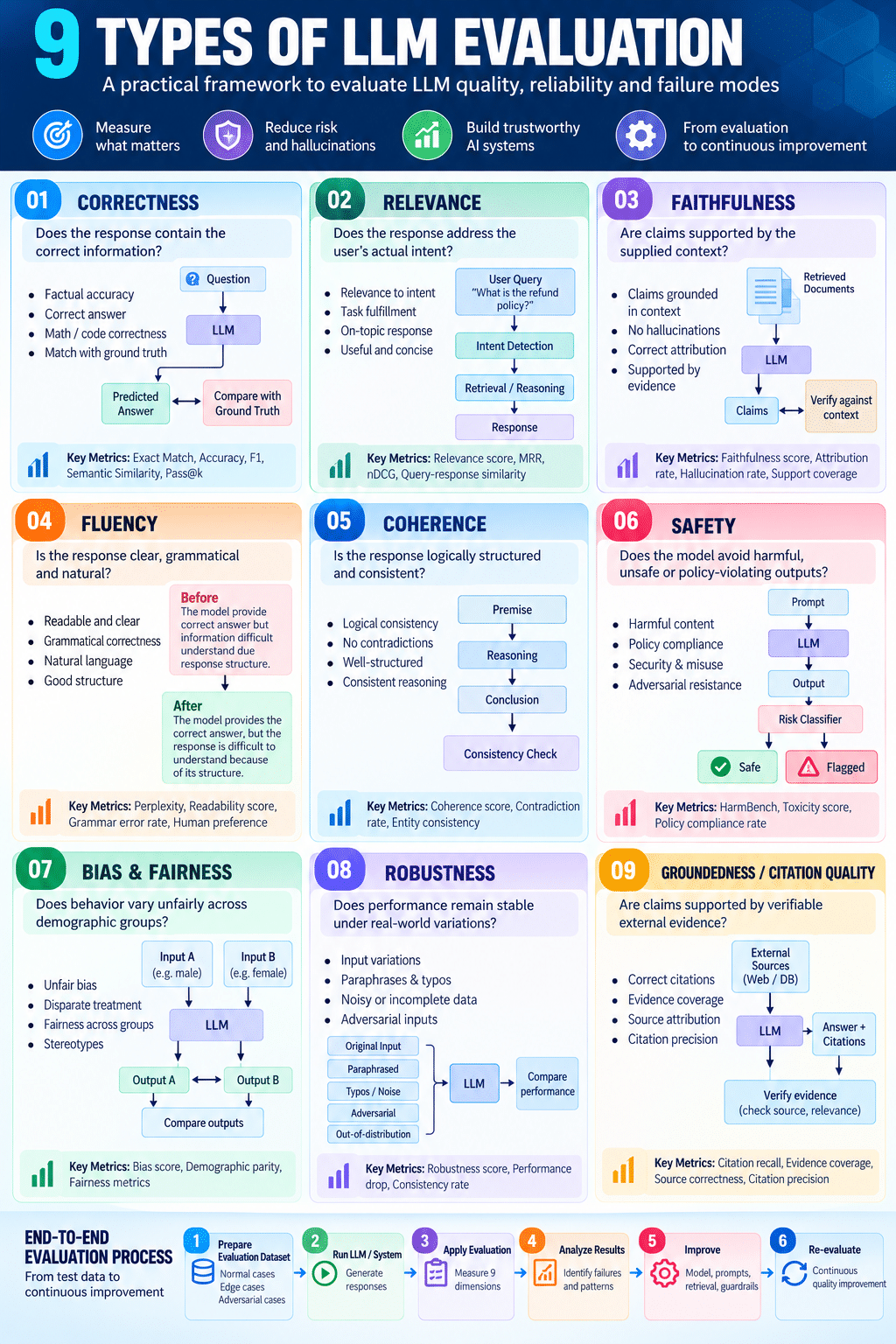
A practical framework organizes evaluation into nine dimensions:
- Correctness
- Relevance
- Faithfulness
- Fluency
- Coherence
- Safety
- Bias & Fairness
- Robustness
- Groundedness / Citation Quality
Let’s walk through each one.
1. Correctness — Did the Model Get the Answer Right?
This is the most obvious dimension, and still the one people over-index on.
The core question is simple: Does the response contain the correct information?
When a clear ground-truth answer exists, we compare the model’s output against it. We care about factual accuracy, mathematical correctness, code that actually runs, and whether the answer matches the reference.
Imagine an AI recruitment system asked: “What is the candidate’s total years of experience?”
The resume shows eight years. The model returns eleven. That is simply incorrect.
For deterministic tasks the evaluation path is straightforward:
Question → LLM → Predicted Answer → Compare with Ground Truth
Useful metrics include Exact Match, Accuracy, F1, Semantic Similarity (BERT Score and similar), Pass@k for code, and actual execution results.
But correctness alone is never enough. An answer can be factually right and still completely useless. That brings us to the next dimension.
2. Relevance — Did the Model Answer the User’s Actual Question?
A model can produce a beautifully written, factually accurate response that has almost nothing to do with what the user asked.
The real question becomes: Does the response address the user’s actual intent?
This matters enormously for chatbots, search assistants, customer service agents, enterprise copilots, and any system that has to interpret messy human requests.
User asks: “What is the refund policy for annual subscription’s?”
A long explanation of the entire pricing structure may contain correct information, yet still fail the user.
Architecturally this means we often need an explicit intent layer:
User Query → Intent Detection → Retrieval / Reasoning → Response → Relevance Evaluation
Metrics that help here include relevance scores, MRR (Mean Reciprocal Rank), nDCG (Normalized Discounted Cumulative Gain), query-response similarity, and LLM-as-a-judge evaluations. In agentic systems this separation becomes especially valuable because the same query can trigger very different workflows.
3. Faithfulness — Is the Answer Supported by the Context?
This is one of the most critical evaluations for any RAG system.
Are the claims in the response actually supported by the information that was supplied to the model?
A medical knowledge assistant retrieves documents that say Treatment A should be considered for patients meeting conditions X and Y. The model replies that Treatment A is recommended for all patients. The answer sounds plausible, but it is not faithful to the retrieved context.
The evaluation pattern is:
Documents → Retrieved Context → LLM → Claims → Verify Claims Against Context
Important distinction: Faithfulness is not the same as correctness. A response can be perfectly faithful to bad retrieved documents and still be factually wrong. That is why we need multiple evaluation dimensions working together.
Key metrics include faithfulness score, attribution rate, hallucination rate, and support coverage.
4. Fluency — Is the Response Clear and Natural?
Fluency asks whether the response is linguistically clear, grammatical, readable, and natural.
It can feel secondary to correctness, yet poor communication makes even a correct system hard to use.
Compare these two versions of roughly the same idea:
Before: “The model provide correct answer but information difficult understand due response structure.”
After: “The model provides the correct answer, but the response is difficult to understand because of its structure.”
Metrics include perplexity, readability scores (Flesch and others), grammar error rate, and human preference or LLM-as-a-judge ratings. For conversational systems, human evaluation remains particularly useful.
5. Coherence — Does the Reasoning Hold Together?
Fluency and coherence are different. A response can be grammatically perfect and still logically broken.
Coherence asks: Is the response logically structured and internally consistent?
Consider: “The customer has no outstanding balance. Therefore, the customer must pay the outstanding balance of $2,500.”
The individual sentences make sense. Together they contradict each other.
We evaluate logical consistency, contradictions, entity consistency, and the integrity of multi-step reasoning. In multi-turn systems this becomes even more important. Production architectures can introduce explicit consistency checks for high-risk workflows rather than relying solely on the LLM.
6. Safety — Can the System Produce Harmful or Non-Compliant Outputs?
A production system must answer a hard question: What happens when someone asks for something the system should not provide?
Safety covers harmful content, self-harm, illegal activity, security abuse, misinformation, policy violations, and adversarial prompts.
A simple conceptual flow is:
Prompt → LLM → Output → Risk / Safety Classifier → Safe or Flagged
Mature architectures enforce policy at multiple points: input policy, model policy, tool/action policy, and output policy. This is where an AI Control Plane becomes valuable. The execution layer performs the task. The control layer decides what is allowed.
7. Bias & Fairness — Does the System Behave Consistently Across Groups?
AI systems can produce different outcomes for different demographic or protected groups.
The question is whether the model behaves fairly across the groups that matter for the application.
We look for disparate outcomes, stereotypes, demographic parity issues, and counterfactual consistency. In a recruitment system, for example, we might test whether equivalent candidate profiles receive materially different recommendations when irrelevant demographic attributes are changed.
The evaluation pattern is straightforward: run parallel inputs that differ only in the protected attribute and compare the outputs systematically. Fairness testing needs to be systematic, not a handful of hand-picked examples.
8. Robustness — Does the System Survive Real-World Variation?
A model can look excellent on clean benchmarks and still fail in production. Production inputs are messy. Users misspell words, use different terminology, provide incomplete information, paraphrase, mix languages, and occasionally try adversarial inputs.
Robustness asks whether performance remains stable under realistic variations.
We test paraphrases, typos, noise, adversarial prompts, and out-of-distribution inputs, then measure the performance drop. Metrics include robustness score, performance degradation (Δ), and consistency rate under perturbation. This dimension is especially important because production data almost never looks exactly like the benchmark data the model was tuned on.
9. Groundedness & Citation Quality — Can We Verify the Evidence?
This dimension becomes critical for enterprise RAG and research systems.
Can the generated claims be traced to verifiable evidence?
There is a meaningful difference between “The answer sounds correct” and “I can verify why this answer is correct.” strong enterprise systems increasingly aim for the second standard.
The flow looks like:
External Sources → Retrieval → LLM → Answer + Citations → Evidence Verification
We evaluate citation precision, citation recall, evidence coverage, source correctness, and attribution quality. This matters most in healthcare, financial services, legal, compliance, and scientific applications.
The Bigger Architectural Picture
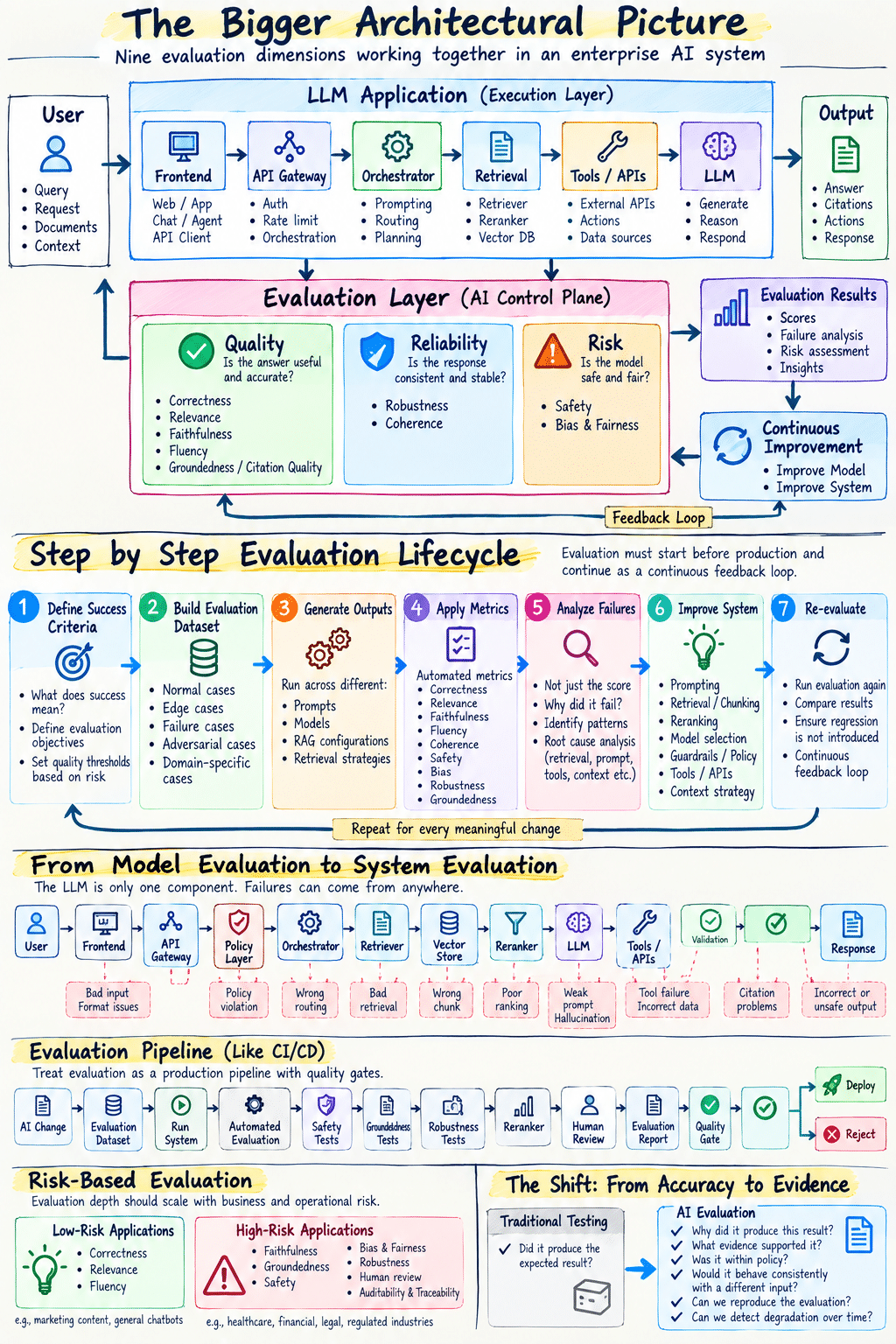
These nine dimensions should not live as nine disconnected tests. They form an evaluation architecture.
Think of the LLM application as sitting above an evaluation layer that looks at Quality (Correctness, Relevance, Faithfulness, Fluency, Groundedness), Reliability (Robustness, Coherence), and Risk (Safety, Bias). The results feed continuous improvement of both the model and the surrounding system.
This changes the engineering conversation. Instead of asking “Which LLM should we use?” we start asking “What behavior does the system need to demonstrate, and how will we prove it?”
Evaluation Must Start Before Production
A common mistake is treating evaluation as something that happens after development. A stronger lifecycle looks like this:
- Define what success actually means for this system.
- Build a representative evaluation dataset that includes normal cases, edge cases, failure cases, adversarial cases, and domain-specific cases.
- Generate outputs across different prompts, models, RAG configurations, and retrieval strategies.
- Apply automated metrics.
- Perform failure analysis — not just the score, but why the system failed.
- Improve the prompt, retrieval, chunking, reranking, model, guardrails, tools, or context strategy.
- Re-evaluate.
Every meaningful change should trigger evaluation again.
This creates a real feedback loop.
From Model Evaluation to System Evaluation
The LLM is only one component. A real enterprise system typically includes frontend, API gateway, policy layer, orchestrator, retriever, vector store, re-ranker, tools, and validation steps. Failures can originate in any of those places: bad retrieval, wrong chunk, missing context, poor ranking, weak prompt, tool failure, hallucination, policy violation, or citation problems.
LLM evaluation is therefore only one part of AI system evaluation.
A Practical Evaluation Pipeline
For a production platform I would treat evaluation like CI/CD:
AI Change → Evaluation Dataset → Run System → Automated Evaluation → Safety Tests → Groundedness Tests → Robustness Tests → Human Review → Evaluation Report → Quality Gate → Deploy or Reject
The quality gate might require correctness, relevance, faithfulness, safety, groundedness, and robustness to meet thresholds defined by the risk profile of the application. Those thresholds are not universal; they depend on the domain and the business consequences of failure.
Evaluation Should Be Risk-Based
A marketing copy generator and a medical decision-support system should not share the same evaluation depth. Evaluation intensity should scale with business and operational risk. Low-risk applications may focus primarily on correctness, relevance, and fluency. High-risk ones need faithfulness, groundedness, safety, bias testing, robustness, human review, auditability, and traceability.
The Most Important Shift: From Accuracy to Evidence
Traditional software testing asks whether the system produced the expected result. AI systems require additional questions:
- Why did it produce this result?
- What evidence supported it?
- Was the response within policy?
- Would the system behave consistently with a slightly different input?
- Can we reproduce the evaluation?
- Can we detect degradation after a model or prompt change?
This is why AI evaluation is becoming an architectural discipline rather than a late-stage testing activity.
Evaluation as Part of the AI Control Plane
I see evaluation as a core component of the AI Control Plane, alongside policy, governance, model routing, memory management, claim/evidence management, observability, and cost controls. The execution plane answers “How do we perform the task?” The control plane answers “Are we allowed to perform it, and did we perform it correctly and safely?”
That distinction grows more important as organizations move from simple LLM applications toward agentic systems.
Final Thought
The future of enterprise AI will not be decided solely by which model posts the highest benchmark score. It will depend on whether organizations can build systems that are correct, relevant, faithful, clear, coherent, safe, fair, robust, and grounded in evidence — and whether those properties can be measured continuously.
For Solution Architects this means evaluation should no longer be an activity added at the end of an AI project. It should be designed into the architecture from day one.
Don’t just build an AI system that can answer. Build an AI system that can prove how well it answers.
That is the difference between an AI demo and an AI engineering system.
Go deeper
Have the same problem, different constraints?
These notes are general by necessity. Tell us the specifics and we will tell you how we would approach it.
We reply within one business day